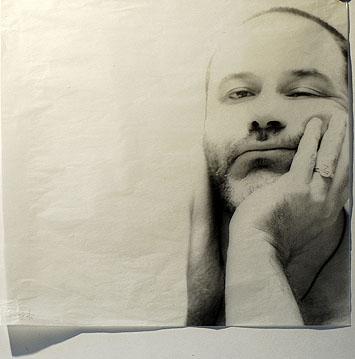
Monday, January 21, 2008

cutting the woodblock

My dear friend,

cutting the woodblock
... IMHO is
about finding the fluid thread
between the hand - tool and the moody viscosity of the wood

... hearing the pulse of the idea merging with a new medium...

it is not in an any way a description of the subject!

i would not try to subdue the wood
rather
tune your flow to the content of the grain or no grain
image is
the child of the two
not a
victim of divorce

yoursimon

PS

I enjoyed cutting the 2x4

Wednesday, September 12, 2007

Edition?

Hello my friends,

I have a question to ask...

It has been simmering for a loooong time...

Why should I limit the edition?

What a dumb idea of faking importance!
...and robbing people of the opportunity to own the work.

I understand if that happened as a result of process (one of a kind) or nobody wants to buy it, or I don't want to make more,
but to limit because some arbitrary number is accepted as a proper and worthy of pay is lunatic.

How many in edition of Greek bronzes? - just think if they would cast only a few?
How many would be lucky to survive?

What we would know if there is none survived for us to see? How many did not survived?!

I understand; to put the number on the casting as keeping truck of how many... (if it really matters?)
it will show by the end what was the real edition...

My experience showed that price (somehow!) does not make much difference in sales after all.
If I would start with lower $ - it does not sale more or faster.

There is some funny number floats for each work which needs to be matched...

People who buy my work are not "limited" by the $, rather by the sense of when and how they can pay it.

The only "legal" meaning of the limited edition implies that it was done by the artist himself or with his approval - what a joke - why I can oversee only 8+4?

The customs law of USA says that only edition under 10 is "unique", France - 8 + 4ap, Britain - 9+2ap, the rest are reproductions and considerate an "industrial production", copies and do not worth as much, so is taxable differently (actually more in European Union).... what a mess!?

What is that idea of the privileged owning the object which nobody else has?
-or even better-
"limited edition of 20000"

Greeks had an established open edition production.
Rembrandt, van Dyck, Goya, Whistler printed their etchings editions as long as plate could handle it - no numbers!
Turner specially painted the watercolors to be reproduced in open edition.

What if , I will from now on keep an edition of all new work open=unlimited ????

thank you all
simon

Sunday, September 24, 2006

I don't know enough...

I don’t know enough about the politics of the art world....

I always believed in an artist not the school -
Which school Rodin or Michelangelo graduated from?

It can be that it is a different times and different rules.... but I doubt it.

There are some things which do not change:
Education is not the title of the school but the student!

You show and sell your art not the copies of your diploma.
Of course the school matters for the beginning of the carrier;
But it is dangerous and wrong if the artist from the beginning thinks about his - hers carrier instead of art.

We have today, way too many examples of the "artists" who have chosen carrier of artist over the making art.
Time will tell.

Tuesday, September 12, 2006

I don’t own the truth… but...

I don’t own the truth … but...

Nobody knows how to photograph the sculpture, especially photographers.

Of course the purpose matters,

For example, if it is for the purpose of archiving

Then – yes, photographer knows, maybe even better for him to do it.

At the same time no photo does justice to the sculpture.

Real experience is reeeeeeaal!

What is real then?

I think it is the energy impregnated in to the sculpture.

It is memory of sensations, struggles and successes compressed

In to the matter of the sculpture.

It is Presence of scale,

Which is not apparent on paper.

So when photographing sculpture, how to address all the above?

That is why photographer can’t!

Oh yes he can, but it will be his “reading” at best.

It is very difffficult because I am not a photographer professionally speaking, I don’t know how to develop or print, I need the genius photographer( I have one) who can hear and I will tell when I’ll see it.

But first is the shot!!!

How to merge in to the future print the experience of the observed?

Slow!

Taking the time to see the work talking, reacting to the light, giving up secrets…

When you hear - then shoot.

I like the view camera because

It allows me

To move the sculpture in the space,

Manipulating the space and sculpture together,

Create the reality needed for particular combination of light, sculpture , distance, Placement on the flat of the viewing glass.

Sometimes I even succeed.